

Índice
Golf pair tournaments have a unique characteristic that radically changes the usual dynamics of the game: performance no longer depends solely on one player, but on both players’ ability to make coordinated decisions under pressure.
From our experience, at Golf Alcanada, we see many pairs arrive with strong individual skills but still make strategic mistakes that ultimately affect the overall result. In this type of competition, emotional management, communication, and tactical course reading become just as important as technique.
For this reason, understanding the most common mistakes in golf pair tournaments allows players to compete more consistently and make better use of each player’s strengths.
Why pair tournaments require a different approach
Unlike an individual round, in golf pair tournaments every decision directly affects your partner.
This involves:
- Greater influence of shared strategy.
- The need to maintain emotional stability together.
- Constant adaptation to the game format.
- Much more important risk management.
As a result, playing well individually does not guarantee good results if there is no real coordination between both players.
Mistake 1: trying to make both players assume the same role
One of the most common mistakes is playing as if both members of the pair had exactly the same responsibilities.
However, in golf pair tournaments:
- Each player usually has different strengths.
- One player may provide more security from the tee.
- Another may stand out in short game or putting.
- Strategy should be built around complementarity.
When both players try to assume the same level of aggression or the same type of shot, unnecessary risky decisions increase significantly.
Mistake 2: making rushed decisions

In pair competition, mental pace often accelerates.
Many pairs:
- Make decisions too quickly.
- Change strategy after a bad shot.
- Become emotionally influenced by their partner.
This usually leads to avoidable tactical mistakes.
For this reason, we recommend:
- Maintaining a stable routine.
- Always confirming strategy before the shot.
- Separating emotion from decision-making.
Tactical clarity greatly reduces mistakes under pressure.
Mistake 3: excessive aggression
In pair formats, players often feel they have “backup” thanks to their partner.
The problem is that this usually causes:
- More unnecessary attacks.
- Poorer shot selection.
- Low-value risks.
Especially in fourball formats, many players force situations because they feel their partner can “save” the hole.
However, tournaments are usually won through consistency, not through spectacular shots.
How to avoid it

The best strategy is usually:
- One player secures position.
- The second player takes more risk only when appropriate.
- Prioritizing high-percentage shots.
Control remains more profitable than constant aggression.
Mistake 4: poor communication
Communication directly influences the pair’s performance.
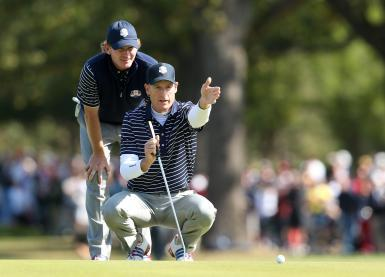
Common mistakes include:
- Negative comments after mistakes.
- Excessive technical analysis during the round.
- Body language that shows frustration.
- Impulsive reactions.
Under pressure, these dynamics affect performance much more than most players realize.
A good competitive pair needs emotional stability in addition to technical skill.
What we recommend at Golf Alcanada
During the round:
- Keep communication simple and clear.
- Avoid correcting technique during play.
- Focus on the next shot.
- Maintain stable positive energy.
Shared confidence improves decision-making and reduces unnecessary tension.
Mistake 5: not adapting strategy to the format
Each format requires different approaches.
For example:
In foursome

- Tee shot positioning is fundamental.
- Control matters more than distance.
- Mistakes are penalized much more.
In fourball
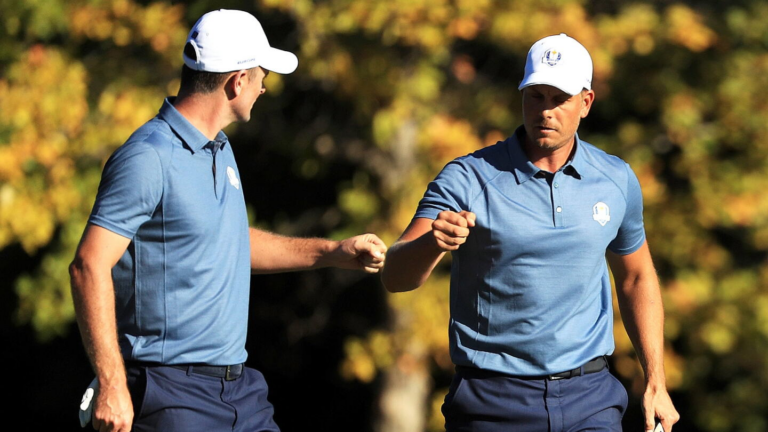
- Conservative and aggressive roles can alternate.
- Risk management changes completely.
- Stability remains essential.
In scramble
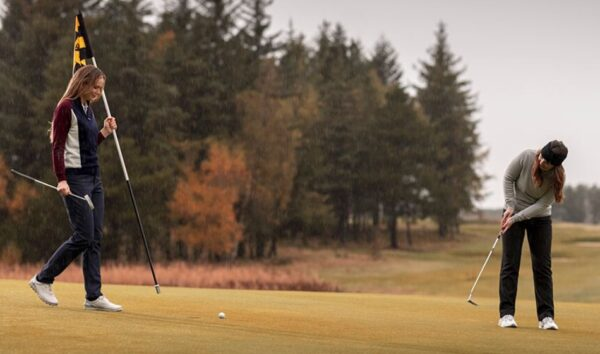
- Individual pressure decreases.
- Many pairs become excessively aggressive.
- Collective strategy makes a major difference.
Failing to understand these differences leads to poor decisions throughout the competition.
Frequently asked questions
Which format is the most demanding in golf pair tournaments?
Foursome is usually considered one of the most demanding formats because both players directly depend on every shot played by their partner. Mistakes have much greater impact, and strategic coordination becomes essential. It also requires constant mental stability and very strong communication throughout the round.
The shared pressure is considerably greater than in more flexible formats.
Is it better to play conservatively or aggressively as a pair?
It depends on the format and the specific tournament situation. However, in most competitions, consistency tends to produce better results than constant aggression. The strongest pairs usually combine safety and risk intelligently.
The key is understanding when to take risks and when to prioritize control.
How does communication influence performance?
Communication directly affects the pair’s confidence and emotional stability. Negative comments, frustration, or excessive analysis create additional tension during the round. On the other hand, simple and clear messages help maintain focus and calmness.
In competition, shared emotional management is just as important as technique.
Can players specifically train for pair tournaments?
Yes. In fact, training together significantly improves tactical coordination and shared decision-making. Practicing strategies, routines, and real situations helps develop mutual confidence. It also allows players to better understand each other’s strengths.
Joint preparation often creates major differences in competition.
Why do some courses increase difficulty in this type of tournament?
Technical courses demand greater strategic precision and penalize collective mistakes more severely. Factors such as wind, slopes, water hazards, or complex greens increase pressure on the pair. On demanding coastal courses, decision-making must be much more precise.
The difficulty of the environment directly influences competitive dynamics.

Golf pair tournaments involve far more than simply putting two good players together. The real difference usually lies in the ability to manage pressure, adapt to the format, and maintain tactical stability throughout the round.
At Golf Alcanada, we work precisely on this type of strategic and competitive golf. Our course combines wind, technical design, and real situations that force players to make constant team decisions.
If you want to improve your competitive performance and develop better tactical awareness in golf pair tournaments, playing in a technical environment like ours makes a real difference in your game.
Learn what golf swing speed is and how to improve it to optimize your game
Discover how to manage pressure on the 18th hole in golf through mental control, smart strategy, and consistent execution under stress
Practical guide to using the natural environment as a distance reference in golf and making better decisions on every shot
Practical guide to handling golf shots from uneven lies and avoiding common mistakes such as hooks or loss of balance
Practical checklist golf summer guide to play in Mallorca heat without losing performance or focus
Grass on golf courses in Mallorca directly affects play and adapts to the climate, influencing bounce, green speed, and strategy
